Zengo alternative — Veyrnox: Shamir instead of MPC, Coercion Resistance
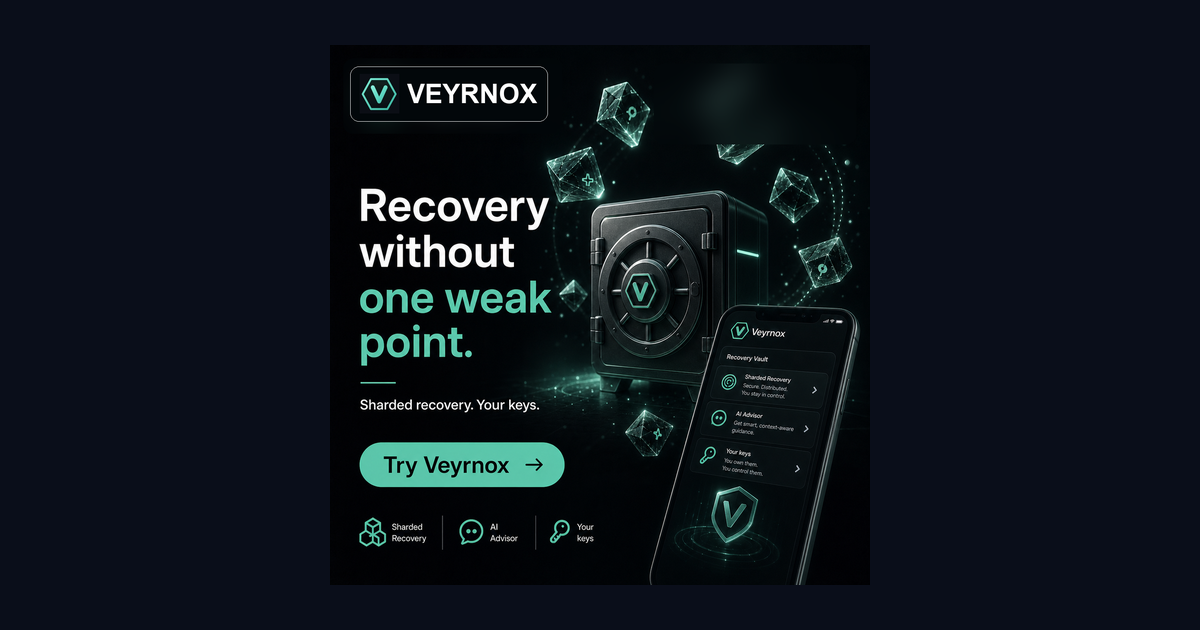
Zengo pioneered no-seed self-custody, and it deserves credit — a decade after BIP-39, they were the first mainstream wallet to convincingly argue you should not have to write twelve words on paper. Their approach uses MPC (Multi-Party Computation) with two shards: one on your device, one on Zengo's server infrastructure. Signing requires both shards, so no single party — including Zengo — can move your assets alone. It works, and it removed the seed phrase. VEYRNOX takes a different bet at the same problem. Instead of MPC with a third-party shard, Veyrnox uses Shamir Secret Sharing with your own iCloud shard. There is no Veyrnox-operated shard, no Veyrnox server that has to stay up for you to sign, no third-party dependency in the trust model at all. Reconstitution happens inside the Secure Enclave on your iPhone, using your device shard plus your iCloud shard. Plus Coercion Resistance on Safety Plus — a decoy wallet Zengo does not ship.
Why users switch from Zengo
Zengo and Veyrnox are the two credible no-seed wallets in 2026, so the switch is not about "one is broken and one is not" — it is about which trust model you prefer. The specific reasons Zengo users move:
- Third-party shard in the signing path. Zengo's MPC design requires a Zengo-operated shard to sign. If Zengo goes down, changes terms, or is compelled, your signing surface is affected. Veyrnox holds no shard — device plus your iCloud is the whole set. Veyrnox can go dark tomorrow and your keys reconstitute in your Secure Enclave using material you already control.
- No coercion mode. Zengo does not ship a decoy wallet. Under duress, your one wallet unlocks. Veyrnox Safety Plus ships a decoy wallet with a plausible balance while your real holdings stay hidden.
- MPC vs Shamir trust model. MPC is elegant math but requires ongoing operational trust in both parties. Shamir splits a key into shards that mathematically combine offline inside your device — no live remote party is in the loop.
- Recovery process depends on the vendor. Zengo's account recovery involves Zengo's infrastructure. Veyrnox's recovery involves iCloud — a Zengo-independent primitive that many users already trust and control.
- Chain coverage. Veyrnox covers the top 10 assets across their native chains with one recovery flow for all of them; hardware-bound signing in the Secure Enclave applies uniformly across BTC, ETH, SOL, and every supported EVM L2.
Veyrnox vs Zengo — feature-by-feature
| Feature | Veyrnox | Zengo |
|---|---|---|
| Self-custody | Yes | Yes |
| Seed phrase shown in UI | No — never | No — never |
| Recovery split scheme | Shamir Secret Sharing | MPC (Multi-Party Computation) |
| Third-party shard in signing path | No — device + your iCloud | Yes — Zengo-operated shard |
| Vendor must stay operational to sign | No — reconstitute in Secure Enclave | Yes — MPC party must respond |
| Hardware-bound signing | Yes — iOS Secure Enclave | MPC signing (software-based) |
| Biometric unlock | Face ID / Touch ID + 8-digit PIN | Face ID + email/3D face |
| Coercion Resistance (decoy wallet) | Yes — Safety Plus $5.99/mo | No |
| RASP tamper detection | Yes — blocks rooted/jailbroken | Limited |
| Trezor pairing | Yes | No |
| Multi-chain (BTC + ETH + SOL + 7 more) | Yes — 10 assets | Yes — broad coverage |
| Browser extension | No — mobile-native only | No — mobile-native |
| iOS app | Yes — iOS-first | Yes |
| Android app | Coming soon | Yes |
| KYC to use | No | Email required |
Migrating from Zengo to Veyrnox
Zengo uses MPC and does not expose a portable seed phrase, so migration from Zengo is a straightforward transfer. If you have a seed phrase from a legacy wallet, Veyrnox can import it; otherwise create a fresh Veyrnox wallet and transfer funds over:
- Install Veyrnox from the App Store and complete the 8-digit PIN plus personal cloud shard setup (iCloud, OneDrive, Google Drive, Dropbox, etc.).
- In Veyrnox, tap Receive on each chain you are moving. Copy the address.
- In Zengo, send each asset to the Veyrnox address on the matching chain. Do a small test send first.
- Repeat per chain. Veyrnox uses one EVM address across Ethereum, Arbitrum, Optimism, Polygon, Avalanche, and BNB Chain.
- If you want to keep Zengo as a secondary wallet during the transition, that is fine — the two use different trust models, and holding some balance in each is a reasonable diversification.
- Once every asset is at Veyrnox and Zengo shows zero, you can decommission Zengo — nothing on Veyrnox depends on it in any way.
Pricing
Free — $0 forever. Full self-custody, hardware-bound signing in the Secure Enclave, optional seed import when needed, and all 10 supported assets (BTC, ETH, SOL, USDC, USDT, MATIC, ARB, OP, AVAX, and BNB).
Safety Plus — $5.99/month. Everything in Free plus Shamir-sharded seed backup across your device and your own cloud (KEK-encrypted shards at rest), and Coercion Resistance — a decoy wallet that unlocks under duress while your real holdings stay hidden.
AI Security Protection — $19.99/month · Coming soon. Everything in Safety Plus plus the AI Security Advisor: real-time warnings on malicious dApps, unsafe DEXs, phishing sites, and AI intervention on Transaction Simulation. See Plans.
All paid tiers are billed through the App Store and can be cancelled any time — self-custody is core to Veyrnox on every tier, so downgrading or cancelling never touches your keys, your balances, or your ability to sign. There is no annual lock-in, no free-trial dark pattern, and no separate exchange or brokerage account attached to your wallet. Compared to Zengo, the whole billing surface is shorter: one wallet, one subscription line item, one place to cancel.
Security model
Veyrnox uses Shamir Secret Sharing to split the material needed to reconstruct your keys into KEK-encrypted shards across your device (Secure Enclave) and your personal cloud (iCloud, OneDrive, Google Drive, Dropbox, etc.). Reconstitution requires both, happens inside the Secure Enclave, and never surfaces a plaintext key. Veyrnox holds no shard, no key, and runs no signing infrastructure — so Veyrnox cannot recover your wallet on your behalf and cannot be legally compelled to hand it over. Every signing operation across BTC, ETH, SOL, and every supported EVM L2 is gated by Face ID or Touch ID and the 8-digit PIN. RASP (Runtime Application Self-Protection) blocks signing on rooted or jailbroken devices and on phones running instrumentation frameworks. And because default setup does not require displaying a recovery phrase, phishing sites lose the most familiar wallet-restore screen by default. For deeper detail see Security at Veyrnox, No seed phrase wallet, Shamir wallet, and Duress wallet.
What Veyrnox does not do
The wallet market is full of adjacent products that quietly grow the trust surface — custodial swap engines, in-app exchanges, embedded lending, tokenised "yield" schemes, referral programs, and airdrop farms. Veyrnox does none of that. There is no in-app buy or sell flow that routes through a Veyrnox-operated custodian. There is no Veyrnox token, no rewards program, and no incentive structure that depends on you moving assets faster than you would otherwise. There is no analytics beacon collecting a fingerprint of what you hold or which dApps you visit — Veyrnox does not know your balance and does not need to. Every paid feature (Coercion Resistance on Safety Plus, the AI Security Advisor on AI Security Protection when it ships) is a security feature, priced as a subscription, billed through the App Store. That deliberate narrowness is what lets the trust model stay small enough to reason about: hardware-bound signing on your iPhone, two Shamir shards you control, one biometric prompt per transaction, and nothing in the middle.
Frequently asked questions
Is Zengo unsafe?
Zengo is not unsafe — it is one of the two credible no-seed wallets in 2026, alongside Veyrnox. The difference is trust model: Zengo requires a Zengo-operated MPC shard, so signing depends on Zengo's infrastructure. Veyrnox uses Shamir with your device shard plus your own iCloud shard — no third-party dependency.
What is the difference between MPC and Shamir?
MPC (Multi-Party Computation) is a live protocol where two or more parties jointly compute a signature without any one party holding the whole key. Shamir Secret Sharing splits a key into shards that combine offline inside your device to reconstitute the key. MPC requires both parties online to sign; Shamir requires only that you hold enough shards.
Can I import my Zengo wallet into Veyrnox?
Zengo uses MPC and does not expose a portable seed phrase, so migration from Zengo is a transfer. If you have a seed phrase from a legacy wallet, Veyrnox can import it; otherwise create a fresh Veyrnox wallet and transfer funds over.
Does Veyrnox depend on Veyrnox the company to sign?
No. Veyrnox holds no shard, no key, and runs no signing infrastructure. Your device shard plus your iCloud shard reconstitute your keys inside your iPhone's Secure Enclave. If Veyrnox went dark tomorrow, you would still hold and sign with your keys.
Does Veyrnox support the same chains as Zengo?
Veyrnox covers the top 10 assets across their native chains — BTC, ETH, SOL, USDC, USDT, MATIC, ARB, OP, AVAX, and BNB. Zengo has broader coverage of long-tail chains; Veyrnox covers the assets that hold most of the value with a hardware-bound signing model.
How does Veyrnox compare on fees?
Veyrnox charges $0 for wallet operations. You pay only each chain's native network fee. Zengo charges a fee on some swap and on-ramp features; Veyrnox does not run those products on the free tier.
How much does Veyrnox cost?
Free forever for full self-custody and Face ID. Safety Plus is $5.99/month and adds Shamir-sharded seed backup plus Coercion Resistance — a decoy wallet Zengo does not ship. AI Security Protection is $19.99/month, coming soon.
When is Android available?
iOS today, Android coming soon. Zengo already ships on Android; Veyrnox is iOS-first because the Secure Enclave, Face ID, and iCloud Keychain give the Shamir hardware-bound model a clean home. Android with StrongBox is on the roadmap.