Multi-chain wallet — 10 chains, one iOS app, real self-custody
The typical crypto user in 2026 does not hold one asset on one chain. They hold BTC as long-term savings, some ETH for gas and DeFi, SOL for fast on-chain moves, stablecoins for actual payments, and one or two L2 or alt-L1 bags that came from a specific dApp or airdrop. Splitting that across four apps means four backup problems, four attack surfaces, and four places where a single mistake ends in a loss.
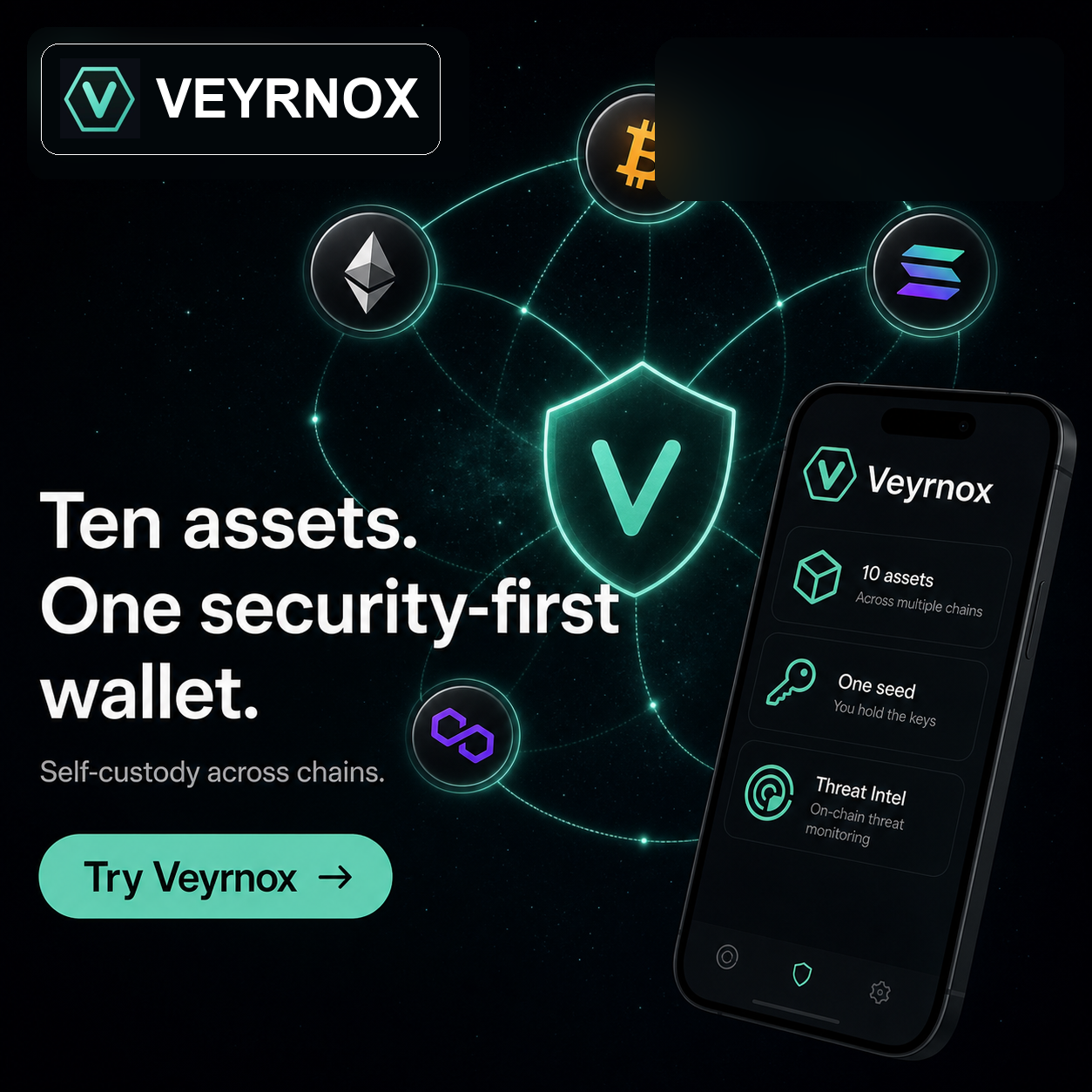
VEYRNOX is a multi-chain wallet for iOS built for exactly that user — the top 10 assets across their native chains, in one self-custody app, with no seed phrase.
Ten chains, one app
Veyrnox natively supports:
- BTC on Bitcoin
- ETH on Ethereum
- SOL on Solana
- USDC on Ethereum, Polygon, Arbitrum, and Solana
- USDT on Ethereum, Polygon, Arbitrum, and Solana
- MATIC on Polygon
- ARB on Arbitrum
- OP on Optimism
- AVAX on Avalanche
- BNB on BNB Chain
All in one app, on iOS, with a single 8-digit PIN and Face ID to unlock.
Cross-chain portfolio view
Every supported asset on every supported chain rolls up into one portfolio dashboard, valued in your local currency. You stop flipping between apps to answer "what do I actually hold". Per-asset views drill down to on-chain balance, transaction history, and per-chain address.
One recovery model for every chain
Multi-chain wallets that rely on a shared seed phrase have one nice property (one backup) and one very bad one (one string of words unlocks everything). Veyrnox keeps the good part and removes the bad part:
- One recovery flow for all supported chains — 8-digit PIN plus a Shamir shard in your personal cloud (iCloud, OneDrive, Google Drive, Dropbox, etc.) (Safety Plus tier).
- No recovery-phrase field in the UI — nothing to write down, screenshot, or paste into a phishing form.
- Hardware-bound signing — every chain's signing keys live inside the Secure Enclave on your iPhone.
- Self-custody on every chain — Veyrnox holds no shard, no key, and cannot sign on any network.
Cross-chain wallet iOS comparison
- Phantom: excellent Solana wallet, limited BTC and multi-EVM reach. Seed-phrase based.
- Trust Wallet: broad multi-chain coverage across BTC / ETH / SOL / EVM L2s, still seed-phrase based.
- Exodus: long-running desktop and mobile multi-chain wallet, seed-phrase based.
- MetaMask: Ethereum + EVM L2s only, no native Bitcoin or Solana. Seed-phrase based.
- VEYRNOX: top 10 assets across BTC / ETH / SOL / EVM L2s / Avalanche / BNB Chain in one iOS app, Shamir-sharded backup, 8-digit PIN, Face ID, hardware-bound signing, WalletConnect v2, no recovery-phrase field.
Connect to dApps on any supported chain
Any dApp or DEX that speaks WalletConnect v2 can request a signature from Veyrnox on any of its supported chains. Review the request in-app, approve with Face ID, sign in the Secure Enclave. Same flow whether the dApp is on Ethereum, Arbitrum, Optimism, Polygon, Avalanche, BNB Chain, or Solana.
How it works
Bitcoin, Ethereum, and Solana use different cryptography and different transaction formats, so a real multi-chain wallet is not one keypair — it is a portfolio of per-chain keypairs held under one recovery scheme. During Veyrnox setup, the app generates the correct keypair for each supported chain (Bitcoin, Ethereum and its EVM-compatible L2s, Solana) inside the Secure Enclave on your iPhone. Private keys never leave the enclave in cleartext; iOS itself cannot extract them. When you send BTC the app assembles a Bitcoin transaction and asks the enclave to sign with the Bitcoin key. When you send ETH or an ERC-20 on Arbitrum, it constructs an EVM transaction and asks the enclave to sign with the secp256k1 key associated with your Ethereum address (the same key signs across every EVM chain you use). When you send SOL or an SPL token, it constructs a Solana transaction and asks the enclave to sign with the Solana key. Every case follows the same pattern: assemble on the client, sign in hardware behind a Face ID prompt, broadcast to the appropriate network's RPC node. Balances and history are read straight from each chain — the wallet is a view onto on-chain state, not a database Veyrnox controls.
Fees
Veyrnox charges $0 for wallet operations across every supported chain. Receive is free. There is no monthly subscription required to send. Your only cost on any given transaction is that chain's native network fee — miner fee in BTC, gas in ETH on Ethereum mainnet, gas in ETH on Arbitrum and Optimism (both L2s pay in ETH), gas in MATIC on Polygon, gas in AVAX on Avalanche, gas in BNB on BNB Chain, and the Solana network fee in SOL. Ethereum mainnet is usually the most expensive; Polygon, Arbitrum, Optimism, BNB Chain, and Solana are usually much cheaper. Veyrnox shows the estimated network fee alongside the amount and recipient on the confirmation screen so you see the full cost before you approve with Face ID. There is no Veyrnox markup on network fees, no in-app percentage take, and no swap spread on receive or send. Advanced features like the duress wallet live on the paid Safety Plus tier; everyday multi-chain self-custody stays on the free plan.
Compared to competitors
Multi-chain wallets on iPhone split into two rough camps. Phantom is excellent on Solana but only recently added meaningful reach into Ethereum and Bitcoin, and its Bitcoin support does not treat BTC as a first-class native asset the way a Bitcoin-first wallet does. Trust Wallet and Exodus cover a much wider chain set — BTC, ETH, SOL, EVM L2s, and dozens of long-tail chains — but keep the classic seed-phrase model, so a single phished 12-word phrase is one drain away from every asset on every chain. MetaMask is EVM-first: Ethereum plus its L2s, no native Bitcoin, no native Solana. Coinbase Wallet spans multiple chains but exposes a recovery phrase, and Coinbase, Binance, and Kraken exchange accounts are custodial — the platform holds your assets and can freeze withdrawals across the whole set at once. Veyrnox targets the specific gap: the top 10 assets across their native chains, in one iOS app, with hardware-bound signing in the Secure Enclave and no seed phrase in the UI. One recovery model — 8-digit PIN plus a Shamir shard in your personal cloud (iCloud, OneDrive, Google Drive, Dropbox, etc.) (Safety Plus tier) — covers every supported chain, so a lost phone does not mean a lost wallet, and a phishing site cannot spoof a seed-phrase input that does not exist.
Security model
A multi-chain wallet is a strictly larger attack surface than a single-chain wallet, and Veyrnox's security model treats that seriously. Every signing operation — on Bitcoin, Ethereum, Solana, or any supported L2 — happens inside the Secure Enclave on your iPhone, gated by Face ID or Touch ID and the 8-digit PIN. The app cannot construct a signed transaction on any chain without an explicit biometric approval on the confirmation screen, and the confirmation screen shows the target, the amount, and the network fee before you approve. Recovery uses Shamir Secret Sharing: the material needed to reconstruct your keys is split into KEK-encrypted shards across your device (Secure Enclave) and your personal cloud (iCloud, OneDrive, Google Drive, Dropbox, etc.). Reconstitution requires both. Veyrnox holds no shard, which means Veyrnox cannot recover your wallet on your behalf and cannot be legally compelled to hand it over — on any of the supported chains. Runtime Application Self-Protection blocks signing on rooted or jailbroken devices and on phones running instrumentation frameworks. And because the app never displays a recovery phrase, phishing sites cannot spoof a UI that does not exist. For deeper detail see Security at Veyrnox, No seed phrase wallet, and Shamir wallet.
iOS today. Android coming soon.
AI Security Protection across every supported chain
A multi-chain wallet is a multi-chain attack surface. AI Security Protection — $19.99/mo, coming soon — is the Veyrnox tier that layers ten transaction-level defenses on top of the Shamir + Secure Enclave signing core, and every one of them applies uniformly across the supported chains rather than only to one ecosystem.
The full ten shipped features: Address Threat Screening (recipient addresses screened via the TIP edge function pre-sign); Phishing Site Detection (curated blocklist — local seed plus remote feed, not an ML classifier); Risk Scoring (nine-signal rule-based composite scorer, deterministic pre-sign); Token Approval Review (view, assess, and revoke ERC-20 and SPL token approvals per spender with risk notes); Approval Monitor (background polling for new approvals and risky incoming transfers — periodic, not push); AI Risk Notes (per-spender annotations sourced from the TIP screening pipeline); Personal AI Advisor (chat interface backed by TIP — advisory, on-demand, not autonomous monitoring); Drainer Detection (local pattern-matching heuristics for known drainer contract shapes); Transaction Explanation (plain-language pre-sign breakdown of what a transaction will actually do); and Portfolio Q&A (ask questions about holdings and on-chain activity in the Advisor chat). See Plans & pricing for the full AI Security Protection tier.
Frequently asked questions
Which chains does Veyrnox support?
Veyrnox supports the top 10 assets across their native chains: BTC on Bitcoin, ETH on Ethereum, SOL on Solana, USDC and USDT on Ethereum, Polygon, Arbitrum, and Solana, MATIC on Polygon, ARB on Arbitrum, OP on Optimism, AVAX on Avalanche, and BNB on BNB Chain.
Can I see all my assets in one place?
Yes. Veyrnox shows a cross-chain portfolio view — every supported asset on every supported chain, in your local currency, in a single dashboard.
Do I have separate seed phrases per chain?
No, and you have no seed phrase at all. One 8-digit PIN plus a Shamir shard in your personal cloud (iCloud, OneDrive, Google Drive, Dropbox, etc.) (Safety Plus tier) reconstitutes keys for every supported chain. Signing keys stay bound to the Secure Enclave on your iPhone.
How does Veyrnox compare to Trust Wallet, Exodus, or Phantom?
Trust Wallet and Exodus are multi-chain but use a shared seed phrase. Phantom is Solana-first and does not natively cover Bitcoin. Veyrnox is multi-chain across BTC, ETH, SOL and their major assets in one iOS app with no seed phrase in the UI.
Can I connect Veyrnox to dApps on any of these chains?
Yes, via WalletConnect v2. Any dApp or DEX that supports the WalletConnect v2 protocol can request a signature from your Veyrnox wallet.
What does Veyrnox charge to send across these chains?
Veyrnox charges $0 for wallet operations on every supported chain. You only pay each chain's native network fee — BTC miner fee, ETH gas, MATIC gas, ARB gas, OP gas, AVAX gas, BNB gas, or SOL network fee — shown on the confirmation screen before you approve with Face ID.
Do I get one recovery flow or one per chain?
One recovery flow for every supported chain. The same 8-digit PIN plus your personal cloud shard (iCloud, OneDrive, Google Drive, Dropbox, etc.) reconstitutes keys for BTC, ETH, SOL, and every EVM L2 you use, with signing keys bound to the Secure Enclave on your iPhone.
Is Android supported?
iOS today, Android coming soon.
Download VEYRNOX →