 VEYRNOX · Ethereum Wallet for iPhone
Ethereum wallet for iPhone — self-custody ETH and ERC-20
Most people looking for an Ethereum wallet on iPhone end up with the same two choices: MetaMask, which was born as a desktop browser extension and still asks you to write down 12 words, or Trust Wallet, which is smoother on mobile but uses the same seed-phrase model. Both put the entire security of your ETH on a string of words you must never lose and never let anyone see.
VEYRNOX is an Ethereum wallet built for the iPhone from day one. Real self-custody of ETH and ERC-20 tokens, hardware-bound signing in the Secure Enclave, and no seed phrase anywhere in the UI.
ETH and ERC-20 support
Veyrnox natively supports ETH on Ethereum mainnet along with the ERC-20 tokens most people actually hold:
- ETH — send, receive, view history.
- USDC — the stablecoin most DeFi and payment flows expect.
- USDT — the largest stablecoin by float.
- Balances shown in your currency, per-token and per-address.
Connect to dApps with WalletConnect v2
Every DeFi protocol, DEX, and NFT marketplace that supports WalletConnect v2 can request a signature from Veyrnox. Scan a QR code on desktop or tap "connect" in a mobile dApp browser, review the request inside the Veyrnox app, and approve with Face ID. The dApp never sees your keys — it sees a signature.
This is the same connection model MetaMask uses, without MetaMask's browser-extension attack surface (malicious extensions, fake pop-ups, hijacked dApp origins).
Gas fee visibility before you sign
Every ETH transaction and ERC-20 transfer shows the recipient, the amount, and the estimated gas on the confirmation screen. Nothing is signed until you approve with Face ID. Contract calls from dApps show the target contract and function so you can catch an unexpected approval before it drains your wallet.
Ethereum wallet iPhone comparison — Veyrnox vs MetaMask vs Trust Wallet
- MetaMask: browser-first history, seed-phrase recovery, growing mobile app but the security model is unchanged — a 12-word phrase is the single point of failure.
- Trust Wallet: mobile-first UX, multi-chain, still seed-phrase based. Same phishing surface.
- Coinbase Wallet: non-custodial companion to the exchange, still exposes a recovery phrase.
- VEYRNOX: iOS-native, Shamir-sharded backup across device (Secure Enclave) and your personal cloud (iCloud, OneDrive, Google Drive, Dropbox, etc.), 8-digit PIN plus Face ID, hardware-bound signing, WalletConnect v2, no recovery-phrase field in the app.
How it works
Veyrnox generates a secp256k1 keypair inside the Secure Enclave on your iPhone during setup. The public key is used to derive your Ethereum address — a standard 0x address that works everywhere Ethereum works, including Layer 2s and any EVM-compatible chain your wallet is configured for. The private key never leaves the enclave in cleartext; iOS itself cannot extract it. Sending ETH or an ERC-20 token constructs the appropriate transaction (a plain value transfer for ETH, a transfer or transferFrom call for ERC-20), hands it to the enclave for signing behind a Face ID prompt, and broadcasts to an Ethereum RPC node. Balances and history come straight from the network — Veyrnox is a view onto on-chain state, not a database it controls. Adding a new ERC-20 asset is a UI-only operation; the same underlying keypair signs for every ERC-20 held at your address.
Fees
Veyrnox charges $0 for wallet operations on Ethereum. Receiving ETH or any ERC-20 token is free, and there is no monthly subscription required to send. The only cost is the Ethereum network gas fee, which is set by the network based on current demand for block space and denominated in ETH. Veyrnox shows the estimated gas alongside the recipient and amount on the confirmation screen — you approve the full picture with Face ID before the transaction is broadcast. There is no Veyrnox markup on gas, no percentage take on the transfer value, and no in-app swap spread. Duress-wallet features and other coercion-response tooling live on the paid Safety Plus tier, but everyday ETH and ERC-20 self-custody stays on the free plan.
Ecosystem support — ERC-20, dApps, and L2s
ERC-20 is the token standard behind essentially every fungible token on Ethereum, including USDC, USDT, and thousands of application and governance tokens. Veyrnox treats ERC-20 as first-class: any ERC-20 held at your address shows up in the portfolio, with balance and history. For DeFi, DEXs, and NFT marketplaces, Veyrnox speaks WalletConnect v2, the same protocol most Ethereum dApps use to talk to MetaMask or a hardware wallet. Scan a QR code on a laptop dApp or tap "connect" in a mobile dApp browser, review the request in-app — the target contract and the function being called are shown — and approve with Face ID. If you also use Ethereum Layer 2s or other EVM chains, the same underlying keypair signs across them; see the multi-chain wallet page for the full list of supported L2s.
Compared to competitors
MetaMask is the default Ethereum wallet for a lot of users, and it earned that position — but it was born as a desktop browser extension, and its security model reflects that origin. Recovery is a 12-word seed phrase the user must protect, and the browser attack surface (malicious extensions, spoofed pop-ups, hijacked dApp origins) is a constant source of drained wallets. Trust Wallet is mobile-first but keeps the same seed-phrase model across all its chains, so a single phished phrase ends the entire wallet. Coinbase Wallet is non-custodial but still exposes a recovery phrase, and Coinbase, Binance, and Kraken exchange accounts are custodial — the platform holds your ETH and can freeze withdrawals. Veyrnox is different in three specific ways. First, it is iOS-native: signing lives in the Secure Enclave rather than a browser extension. Second, there is no seed-phrase field anywhere in the app; recovery is an 8-digit PIN plus a Shamir shard stored in your personal cloud (iCloud, OneDrive, Google Drive, Dropbox, etc.), hardware-bound to your device. Third, Veyrnox holds no shard and no key, so a Veyrnox outage cannot lock you out and a Veyrnox compromise cannot move your ETH. If you want cold storage as well, Veyrnox pairs with a Trezor.
Security model
Ethereum users sign a lot of contract calls, and every extra approval is another chance for a malicious dApp to slip in a hostile instruction. Veyrnox's security model is built for that reality. Signing happens inside the Secure Enclave, gated by Face ID or Touch ID and the 8-digit PIN — the app cannot sign an Ethereum transaction without an explicit biometric approval on the confirmation screen, and the confirmation screen shows the target contract and the amount before you approve. Recovery uses Shamir Secret Sharing: the material needed to reconstruct your keys is split into KEK-encrypted shards across your device (Secure Enclave) and your personal cloud (iCloud, OneDrive, Google Drive, Dropbox, etc.). Reconstitution requires both. Veyrnox holds no shard, which means Veyrnox cannot recover your wallet on your behalf and cannot be legally compelled to hand it over. Runtime Application Self-Protection blocks signing on rooted or jailbroken devices and on phones running instrumentation frameworks. And because the app never displays a recovery phrase, phishing sites cannot spoof a UI that does not exist — there is no 12-word input for an attacker to imitate. For deeper detail see Security at Veyrnox, No seed phrase wallet, and Shamir wallet.
AI Security Protection for Ethereum and dApp users
Ethereum on iPhone means WalletConnect sessions, ERC-20 approvals, and DEX signatures — the exact surface where drainer contracts and unlimited-approval traps do their work. AI Security Protection — $19.99/mo, coming soon — is the Veyrnox tier that layers pre-sign and post-approval threat intelligence on top of the wallet's Shamir + Secure Enclave core.
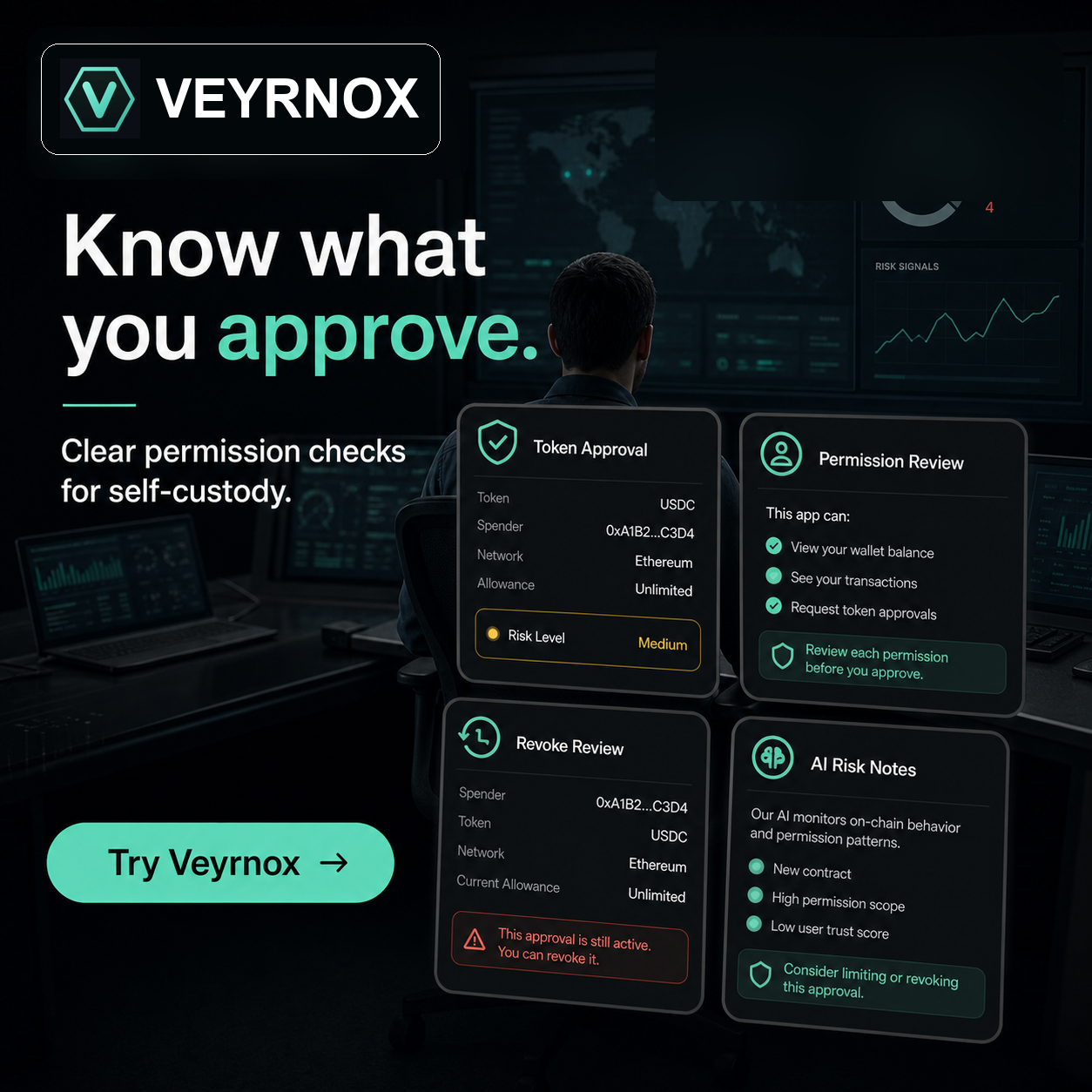
Four of the tier's shipped features carry the load on ETH. Token Approval Review lists every ERC-20 allowance you've granted, annotates each spender with per-address risk notes, and lets you revoke in a tap. Approval Monitor is a background poller (periodic, not push) that alerts you when a new approval or a risky incoming transfer lands on a watched address. Risk Scoring is a nine-signal, rule-based composite scorer that runs pre-sign — deterministic, not a learned model — so you see a numeric risk read on the DEX swap or dApp call before you approve. Drainer Detection is a local heuristic pass that pattern-matches known drainer contract shapes and warns before you sign. Together with Phishing Site Detection (curated blocklist, not a classifier) this covers the WalletConnect and DEX phishing surface. See Plans & pricing for the full AI Security Protection tier.
Why this matters for an eth wallet on iOS
The most common ETH loss vector is not a broken protocol — it is a phishing message that says "verify your wallet" and shows a 12-word input. Veyrnox does not have that input. A phishing site cannot mimic a UI that never asks for a phrase, because the real app never asks either.
iOS today. Android coming soon.
Frequently asked questions
Does Veyrnox support Ethereum on iPhone?
Yes. Veyrnox supports ETH natively on iOS, along with major ERC-20 tokens including USDC and USDT.
Can I connect Veyrnox to Ethereum dApps?
Yes. Veyrnox connects to dApps and DEXs using WalletConnect v2, so any DeFi protocol that supports WalletConnect can request a signature from your wallet. You review the request in-app and approve with Face ID before anything signs.
How is Veyrnox different from MetaMask on iOS?
MetaMask stores a 12-word seed phrase the user must back up. Veyrnox has no seed-phrase field in the UI — recovery is an 8-digit PIN plus your personal cloud shard (iCloud, OneDrive, Google Drive, Dropbox, etc.), with signing keys bound to the Secure Enclave.
Does Veyrnox show gas fees before I sign?
Yes. Estimated gas is displayed on the confirmation screen alongside the recipient and amount before you approve with Face ID.
Is my ETH self-custody?
Yes. Veyrnox holds no shard, no key, and cannot sign for you. Your ETH lives at an Ethereum address only your iPhone can sign for.
What does Veyrnox charge to send ETH or an ERC-20 token?
Veyrnox charges $0 for wallet operations on Ethereum. You pay only the Ethereum network gas fee, which is set by the network, denominated in ETH, and shown on the confirmation screen before you approve with Face ID.
Do I need separate wallets for USDC and USDT?
No. Any ERC-20 token — including USDC and USDT — held at your Ethereum address appears in the same Veyrnox portfolio and is signed by the same underlying keypair inside the Secure Enclave.
Is Android supported?
iOS today, Android coming soon.
Download VEYRNOX →