
Seedless crypto wallet: what it is and how it works in 2026
By Al Jobson · 11 min read · September 2026
The 12-word seed phrase is now the most-exploited primitive in crypto. Scam Sniffer counted $494M drained across 332,000 addresses in 2024 from signature phishing alone[1]; the FBI's IC3 attributed the majority of retail crypto losses to social engineering that ends in a stolen phrase or an approved malicious signature[2]. A seedless crypto wallet is any self-custody wallet that removes the 12/24-word phrase from the user experience: the signing key lives inside secure hardware, is split across parties, or both. This piece explains the category, what "seedless" actually means, how the three main designs work, and where each one stands in 2026.
What "seedless" means, precisely
A traditional self-custody wallet (MetaMask, Trust, Phantom, Ledger, Trezor) is a BIP-39 wallet[3]. At setup, the wallet generates 128 or 256 bits of entropy, encodes it as a 12 or 24-word mnemonic, and derives every subsequent private key from that seed using BIP-32[4]. The mnemonic is the wallet. Anyone who types it into any compatible wallet gets full control.
A seedless wallet breaks that identity. It comes in three shapes:
- Enclave-only. The private key is generated inside the phone's Secure Enclave (Apple) or StrongBox / TEE (Android) and can never be read out[5][6]. Signing happens inside the chip. If the phone dies with no backup, the wallet is gone. Passkey-based wallets like WebAuthn signers fall here.
- MPC / threshold signatures. The private key never exists as a single object. Two or more parties each hold a share and jointly compute a signature. Retail examples: ZenGo, Coinbase Wallet (via WaaS), Web3Auth. Institutional: Fireblocks, Copper, Anchorage.
- Enclave + Shamir Secret Sharing (SSS). The signing key lives in the enclave (same as design 1); the backup is split into m-of-n shares distributed across trusted devices, people, and encrypted cloud storage[7]. This is the model VEYRNOX and Trezor's SLIP-39 use[8].
All three are still self-custody. No provider can move funds without the user's device or the user's shares. What differs from a BIP-39 wallet is that nothing in the user's daily life looks like a seed phrase: no 12 words to store, to lose, or to be phished for.
Why the seed phrase became a liability
BIP-39 was written in 2013 for a world of desktop wallets, used by people who could be trusted to manage a piece of paper[3]. The user base is now hundreds of millions, most of them on mobile, and the attack economy has industrialised. Chainalysis measured $2.2B stolen from crypto services and wallets in 2024 across 303 incidents; the H1 2025 figure alone was $2.17B, dominated by the $1.5B Bybit exploit in February, the largest single crypto theft on record[9][10]. On the retail side, drainer kits sold on Telegram now ship with fake wallet-restore UIs designed to harvest seed phrases at scale[11].
Three properties of a BIP-39 seed make it a hard primitive to defend:
- It is a single object. One photograph, one dictated string, one screenshot ends the wallet.
- It is user-visible. Any UI that shows it can be spoofed by any UI that looks like it.
- It is portable. It restores into any compatible wallet without any second factor.
Seedless designs each remove one or more of those properties.
The three designs, side by side
| Property | Enclave-only | MPC / TSS | SSS + enclave |
|---|---|---|---|
| Private key exists as one object? | Yes, sealed in Secure Enclave / StrongBox | Never | Yes, sealed in enclave; never exported |
| User-visible secret | None | None | None (shares distributed once at setup) |
| Recovery model | Passkey sync / iCloud Keychain | Reshare / key refresh with provider | Reconstruct m-of-n shares |
| Provider dependency | Apple / Google for backup | Provider holds one share | None if shares are user-held |
| Coercion resistance | Weak by default | Depends on policy engine | Depends on duress features |
| Examples | Passkey signers, some Argent Vaults | ZenGo, Coinbase WaaS, Fireblocks | VEYRNOX, Trezor SLIP-39 backups |
MPC in detail
Multi-party computation replaces the private key with a joint signing protocol. Two or more parties each hold a share and interactively compute a signature that verifies against a single public key on-chain. From the chain's perspective it looks like a normal signature. From the wallet's perspective the private key never exists on any single machine.
The reference protocols for threshold ECDSA are GG18 and GG20 by Gennaro and Goldfeder[12]. Two-party retail wallets typically use Lindell's 2017 construction[13]. MPC security is protocol-dependent, not automatic. Verichains disclosed TSSHOCK against GG18/GG20 in 2023, letting a malicious party extract the full key over the signing protocol; several deployed wallets patched[14]. Trail of Bits and NCC Group have published multiple reviews since[15].
The retail MPC user experience is clean: no phrase, biometric sign-in, and recovery through a key refresh with the provider. The trade is that the provider sits on the critical path. If it disappears, so does the ability to sign. Most retail MPC vendors mitigate this with an escape hatch that exports the key material to a Shamir-style backup, which puts them back in the same trust model as design 3.
Shamir Secret Sharing plus enclave in detail
Adi Shamir published the underlying scheme in 1979[7]. A secret S is split into n shares such that any m of them reconstruct S and any m-1 reveal nothing. For a wallet, the secret can be the seed of a BIP-32 tree, a wrapping key for the enclave-held signing key, or the enclave export blob.
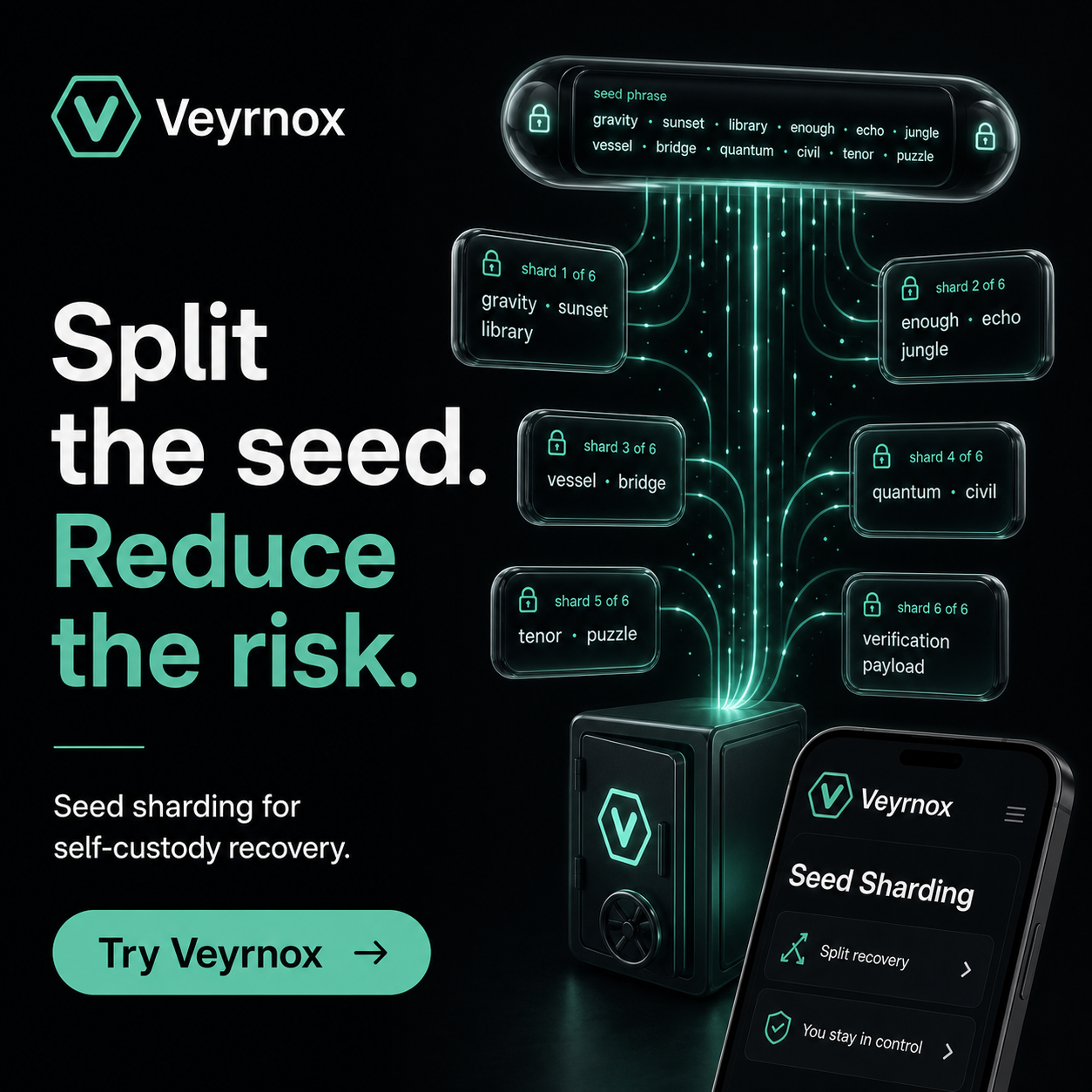
In the enclave-plus-Shamir design used by VEYRNOX, the signing key is generated by the Secure Enclave and never leaves the chip. What gets split into m-of-n shares is the encrypted export blob, recoverable only when the required threshold of shares is combined. Shares are distributed at setup to locations the user controls: a second device, a partner, an encrypted cloud, offline paper or metal. No provider sits on the critical path and no single object is available to steal.
SatoshiLabs standardised the same primitive as SLIP-39 in 2017; Trezor Model T ships it as an option[8]. The trade against MPC: a signing key does exist as one object inside the enclave. The security floor is the hardness of the enclave, which is a known and audited quantity[5].
What seedless does not fix
Removing the seed phrase closes two attack vectors: phrase phishing and physical seed extraction. It does not close others.
- Blind signing. Every wallet that displays a hash and asks for approval can be tricked. Ledger's Clear Signing initiative and Blockaid's signature simulation exist because approvals, not keys, are where most money now leaves[16].
- Approval phishing. Setting an unlimited ERC-20 allowance to a malicious contract lets that contract drain later. Revoke.cash tracks tens of millions in exposure at any time[17].
- Coercion. A wrench attack does not care what is under the hood. Jameson Lopp's running index of documented physical attacks on crypto holders passed 170 incidents by mid-2025[18]. Duress PINs, decoy accounts, and threshold policies address this layer; a seedless design without them is not more resistant than a hardware wallet.
- Device compromise at sign time. Malware on the phone that hijacks the confirmation UI can still authorise a signature. Enclave and MPC both raise the bar but do not eliminate the class.
Market state, 2026
| Wallet | Design | Audience | Notes |
|---|---|---|---|
| VEYRNOX | Enclave + SSS backup | Retail iOS + Android | No provider on critical path; duress PIN in Safety Plus tier |
| ZenGo | 2-of-2 MPC | Retail | Provider holds one share; face-scan recovery |
| Coinbase Wallet (WaaS) | 2-of-2 MPC | Retail + developer platform | Backed by Coinbase custody |
| Web3Auth | SSS via social login | Developer SDK | Shares split OAuth / device / user secret |
| Argent (Vault) | Smart-contract multisig + guardians | EVM retail | On-chain recovery via guardians |
| Fireblocks | Enterprise MPC + policy engine | Institutional | $8B valuation, last raised 2022[19] |
| Portal | MPC SDK | Embeddable | Wallet-as-service for apps |
| Turnkey | TEE-based key infra | Developer | Nitro enclaves, policy-driven signing |
The retail category is fragmenting between "no phrase, provider co-signs" (MPC) and "no phrase, keys stay on your phone" (enclave-plus-Shamir). The institutional category has consolidated on MPC with policy engines. What is absent on the retail side is any pure enclave-only design with no backup: the recovery UX is worse than a lost seed phrase.
How to evaluate a seedless wallet
- Who has to be alive for you to sign? If the answer is "just me and my device", you have full self-custody. If it is "me and the provider", the provider sits on the critical path.
- What does recovery cost in trust? Passkey sync trusts Apple or Google. MPC provider recovery trusts the provider. Shamir recovery trusts the human network you distributed shares to.
- What does the wallet do at signing time? Any wallet that shows a hash and asks for approval will lose funds to signature phishing. Look for transaction simulation, contract-name resolution, and hard blocks on known drainers[20].
- What does the wallet do under coercion? Ask specifically. A "seedless" wallet with no duress model is not more coercion-resistant than a Trezor.
- Has the crypto been reviewed? For MPC, look for named audits of the specific protocol version. GG18/GG20 breakage is protocol-specific and public[14]. For enclave designs, look for use of Apple's Secure Enclave and Android's hardware-backed Keystore, not just a "biometric" claim[5][6].
Bottom line
The seed phrase solved a real problem in 2013 and created a bigger one by 2024. Every credible measurement (Chainalysis, Scam Sniffer, TRM Labs, IC3) points at phrase phishing and blind signing as the two loss vectors that now dominate retail self-custody[1][2][9][21]. Seedless designs (MPC, Shamir plus enclave, and their hybrids) are the category answer to the first. Signature simulation and duress features answer the second and third.
The right seedless wallet for a retail user in 2026 is one where the keys live in your phone's secure hardware, the backup is m-of-n shares you distributed yourself, and the signing UX makes it hard to approve something you don't understand. That is the shape VEYRNOX ships. It is not the only shape, and where the trade-offs land for you is the question this article was written to make easier to answer.
Try the seedless model
VEYRNOX is a seedless, self-custody wallet for iOS and Android. Keys are generated and used inside the phone's Secure Enclave; backup is Shamir m-of-n; the Safety Plus tier adds decoy PIN and duress protection. Download or read the security model.
Sources
- Scam Sniffer, "2024 Wallet Drainers Report." drainer.io
- FBI IC3, "Cryptocurrency Fraud Report 2023." ic3.gov
- BIP-39, Mnemonic code for generating deterministic keys. github.com/bitcoin/bips
- BIP-32, Hierarchical Deterministic Wallets. github.com/bitcoin/bips
- Apple, "Secure Enclave overview." support.apple.com
- Android, "Hardware-backed Keystore / StrongBox." source.android.com
- Shamir, "How to Share a Secret" (1979). dl.acm.org
- SLIP-39, Shamir's Secret-Sharing for Mnemonic Codes. github.com/satoshilabs
- Chainalysis, "2025 Crypto Crime Report." chainalysis.com
- Elliptic, "Bybit hack analysis." elliptic.co
- SlowMist, "Wallet Drainer as a Service." slowmist.medium.com
- Gennaro, Goldfeder, "GG18/GG20 threshold ECDSA." eprint.iacr.org
- Lindell, "Fast Two-Party ECDSA." eprint.iacr.org
- Verichains, "TSSHOCK." verichains.io
- Trail of Bits, "MPC / TSSHOCK analysis." blog.trailofbits.com
- Ledger, "Clear Signing initiative." ledger.com
- Revoke.cash, allowance dashboard. revoke.cash
- Lopp, "Known Physical Bitcoin Attacks." github.com/jlopp
- Fireblocks Series E, $8B valuation. fireblocks.com
- Blockaid, transaction simulation. blockaid.io
- TRM Labs, "2025 Crypto Crime Mid-Year." trmlabs.com
- Kraken Security Labs, Trezor seed extraction. blog.kraken.com
- wallet.fail at 35C3. wallet.fail
- Ledger, "Recover FAQ." ledger.com
- Casa, multisig product docs. keys.casa
- NIST SP 800-63B, "Digital Identity Guidelines." nist.gov
- WebAuthn Level 3 spec. w3.org
Al Socrates Jobson, Co-Founder & CTO, Veyrnox LTD · ← Back to Blog